Friday, November 16, 2012
CVABA at the VMFA for FA&F!
Fine Art and Flowers at the VMFA (by Judy Thomas)
The Virginia Museum of Fine Arts http://www.vmfa.state.va.us/Default.aspx has an exhibit every other year, Fine Arts and Flowers. For the exhibit, which occurs over a long weekend, the VMFA invites area garden clubs to create a floral work that somehow represents, symbolizes, interprets or echoes a pre-selected group of art work at the museum. These garden clubs go all out to create floral masterpieces! For a view and details of works from the most recent show, go to https://vmfa.box.com/s/d517331ac9495203e015/1/453849957
Our group, pictured above, was delighted with the exhibit, lead by docent, CVABA member and Ginter Gardens Botanical Illustration Program teacher, Celeste Johnston. I thought I would like the interpretation of traditional art the best, but it was the modern art-related floral arrangements that most caught my imagination, though all were lovely, using wonderful materials. I snapped a few photos with my Ipad, and two of the modern interpretations came out well. Group members, comprised of botanical illustrators and artists, were delighted to see the art and flowers. I felt the floral arrangements helped me appreciate the art in a a new way!
Look for this exhibit in 2014!
"Earth laughs in flowers." Ralph Waldo Emerson
Thursday, November 1, 2012
Botanical Needle Arts
Other Media: Botanical Needle Art
by Judy Thomas
When I first started botanical illustration/art classes, I was quickly disabused of the notion that this type of art was pretty much restricted to watercolor. Botanical artists use many media, including watercolor, graphite, pen and ink, colored ink, oil paint, gouache, pastel and colored pencil. I also discovered that many of my fellow artists were also fiber or needle artists as well, and incorporated botanical images into their work. This inspired me to attempt botanical illustration in a needle art with which I am familiar: needle felting.
Anne McCahill is working on a large project to create large panels of plants and pollinators. She is creating botanical art using embroidery:
Anne McCahill "Coneflower and Bee"
As well as smaller, decorative works:
Anne McCahill "Ixara and Monarch"
Anne works in muslin, duck cotton, and linen. As she writes "I used my lightbox to
draw the outline and painted very diluted shades of the various colors
for the design. [For the stitching] DMC floss works well, mostly using 1 strand for finer
texture and detail... It really parallels sketching or painting, needing
as much patience as the other techniques. The DMC color
chart offers lots of shades, but it would be rewarding to create
botanical hand dyed shades, a project in the offing." Anne also writes "beginners
in stitchery would like Needle Painting Embroidery. Fresh Ideas for
Beginners (Milner Craft Series), available at Amazon."
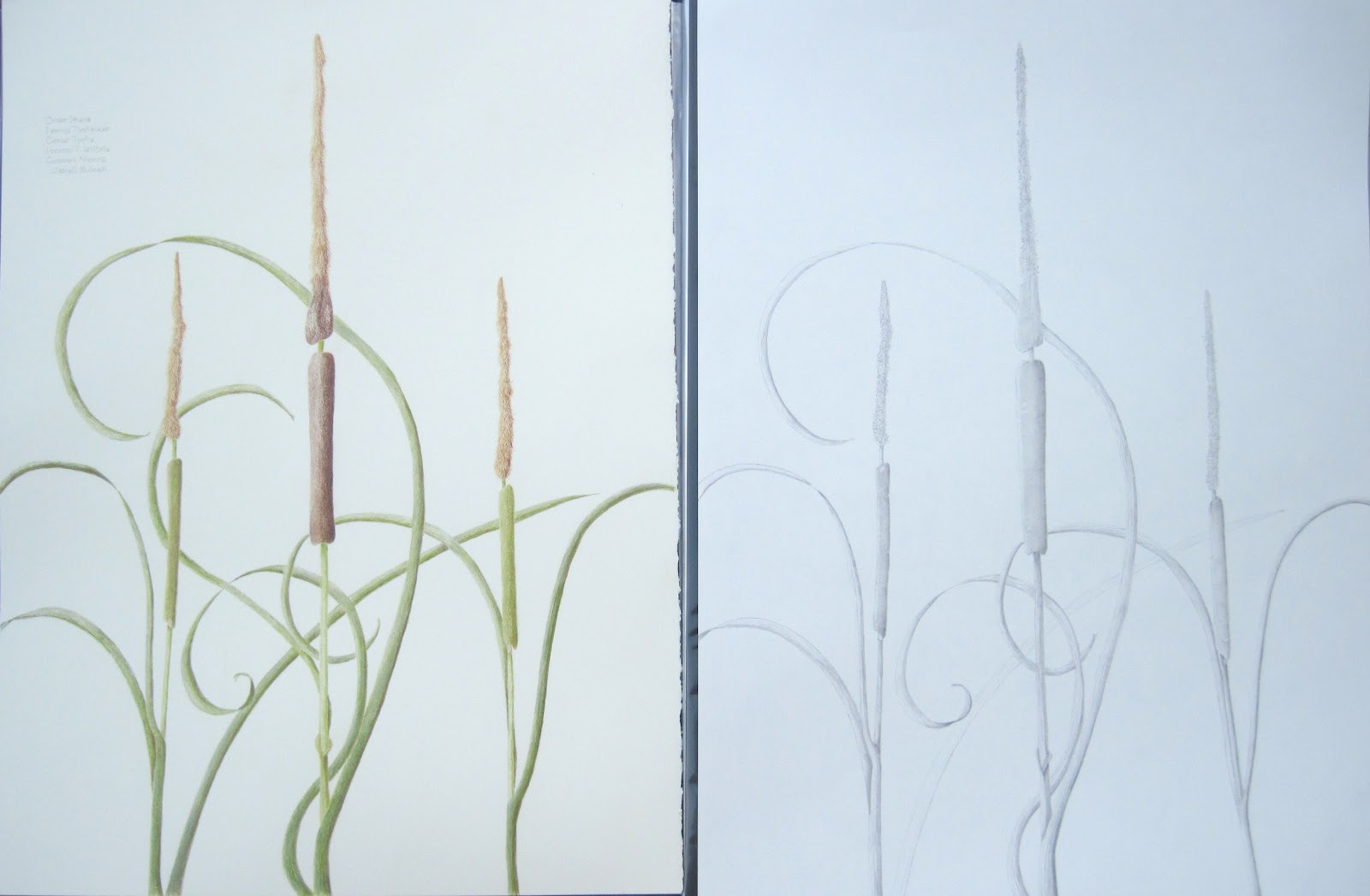
I am also attempting to use needle arts to create botanically-inspired work. Currently, I am finishing an illustration of cattails, also known as bulrush, in needle-felted wool. I sketched the cattails both in graphite and color pencil.
Judy Thomas "Typha latifolia" in colored pencil and graphite
I am now "sketching" it in wool. It is difficult to be as accurate with wool as with graphite or colored pencil, so compromises must be made, while trying to stay as botanically "true" the plant as possible.
Judy Thomas "Typha latifolia" in wool
The Royal Botanic Gardens in Edinburgh, Scotland incorporates fiber arts into their program, including needle felting, web felting, natural dyed fibers and paper making.
http://www.rbge.org.uk/whats-on/events&category=8&category=8&category=8&category=8&category=8&category=8&p=1
On Nov. 3 and 10, 2012, and February 2 and 16, 2013 I am teaching 2-day, beginning needle-felting classes for botanical artists at Lewis Ginter Botanical Gardens. We will learn how to create flat and dimensional botanical art composition in colorful wools, with the conventions of botanical illustration as our guide. I hope the course will be repeated regularly. Go to www.lewisginter.org for more information.
“...the true secret of happiness lies in the taking a genuine interest in all the details of daily life...”
-William Morris
Monday, October 1, 2012
Quarts of Color
Quarts of Color
by Judith Towers
Plants that we love to paint can yield colors used to dye
fibers, stain paper and fabric, and make ink. Celeste Johnston and Hazel Buys
chose Painting Plants that Paint as
the title for their August 2012 botanical art class at Lewis Ginter Botanical
Garden. Finding ways to make plants lend us their colors led to brewing a
potful of dried marigolds, leaf pounding, painting with plant dyes, collecting
promising petals, and watching colors develop on natural fibers in solar dye
jars. We used a process similar to making sun tea. During the four-week class,
students drew many of the plants that filled their solar jars and celebrated
nature's harmonious hues.
We had homework!
Here’s our assignment. Try it! Dye it!
Take a glass quart jar nearly full of flowers.
Add water ¾ full.
Microwave 2 minutes. Wait a minute or two.
Microwave another 2 minutes.
Add clean wet wool yarn or fiber.**
Put on the lid.
Place in a sunny spot.
Stir occasionally.
Be astonished and rewarded.
**Experiments
work better if wool has been treated with potassium alum or ammonium alum
(pickling alum available at your grocery store).
**Acrylic
yarn and most man-made fibers will not work.
Solar Dye with Marigolds
Solar Dye Samples
When Judy Thomas’ friends from India, Swati and her mother
Tarla, visited our class and brought with them cloth from India we were treated
to a festival of colors. Many pieces were examples of khadi cloth, (usually cotton,
but can be silk or wool) handspun, handwoven, and hand dyed. Tarla is a follower of Gandhi and believes in using only hand spun fabrics, dyed from local sources, as an expression of the philosophy of Indian Independence. Some dye plants used in India include blue from indigo, yellow from turmeric, green from a mix of the two, red from onion skins, as well as bark and leaves from eucalyptus (yellows to reds) and bark, leaves and fruit from the mulberry.
Fabrics from India
So go! Capture colors from plants.
Shred flowers and leaves.
Mash berries or juicy fruits.
Grind or chop roots or bark.
Soak nut hulls.
Dye happy!
Fig Leaves
Read more:
Wild Color by
Jenny Dean, Watson Guptill, 1999
A Weaver’s Garden,
Rita Buchanan, Interweave Press, 1987
Harvesting Color,
Rebecca Burgess, Artisan, division of Workman Press, 2011
Eco Colour, India
Flint, Interweave Press, 2010
Color, a Natural
History of the Palette, Victoria Finlay, Random House, 2004
Tuesday, September 25, 2012
Expanding the Roots (of Botanical Art)
Expanding the Roots Advanced Workshop
To register, go to: Expanding The Roots Registration
Celeste Johnston is teaching a new course, "Expanding the Roots," at Lewis Ginter Botanical gardens. Here is what she has to say about this exciting class:
This class is a chance
to place traditional botanical elements and
imagery within a work of art that draws from dreams, poems,
ideas, words and any other thing you can imagine. It is also a chance
to create a botanical work in a nontraditional medium. This class offering is for the student who knows the fundamentals of
botanical art or who has had some previous botanical experience
and wants to add other expressive ideas or use a nontraditional medium such as oil, acrylic and combinations of other
mediums.
Instructor: Celeste Johnston
4 Wednesdays, October 31, November 7, 14, 21, 9:30 am - 2 pmTo register, go to: Expanding The Roots Registration
Sunday, September 2, 2012
Botanical Illustration and Botanical Art
"Yellow Rose" by Hazel Buys
What is botanical illustration? Botanical art? Floral art? The members of CVABA do all three, plus general nature art. But there are differences between the three.
Botanical illustration (BI) is considered a scientific discipline, a subset of scientific illustration. In BI, accuracy and precision are key elements. The plant being depicted must accurately represent the attributes of the plant. For example, a flower needs to have the correct number of petals, stamens and anthers (within reason- some are hidden from the viewer, especially when there are many of them!). The leaves must have correct veining (alternate, opposite or parallel). Colors must be as accurate as possible, though different lighting conditions create some variability in color. The botanical illustrator also strives to depict different parts of the plant (flower, calyx, thorns, hairs, stems, fruit, seeds, leaf and root, for example) in different stages of development. There are also several conventions that are followed: in general, light is depicted as coming from the left: the back of a leaf and underside of the flower should be shown: the plant is drawn life size when possible, and any changes in size from plant to drawing should be indicated: and there is no background nor cast shadow (shadow outside of the dimensions of the plant). Despite these rules, there is still room for artistic expression! BI is traditionally done in watercolor, but it can also be created using graphite (pencil), pen and ink, colored pencil, and other media.
Botanical art is art that depicts any type of plant. It does not need to follow the rules of BI and there is greater latitude regarding how the plant is depicted. Many media can be used. Floral art is similar to botanical art, but focuses on flowers.
Follow us to see examples of each over the coming months!
"Nobody sees a flower really; it is so small. We haven't time, and to see takes time - like to have a friend takes time." Georgia O'Keeffe
Friday, August 3, 2012
CVABA
Welcome to Central Virginia Botanical Artists, CVABA!
Who are we? CVABA is a circle of artists who are interested in many aspects of the natural world, mostly plants and flowers, but also pollinators and other animals. We draw, paint and photograph the natural world to convey the sense of wonder and beauty we experience when we engage with nature. Many of us are current or former students and teachers at Lewis Ginter Botanical Gardens Botanical Illustration Program (http://www.lewisginter.org/). Some of us have gallery space, sell our work commercially, are educators or engage in art for sheer pleasure. Most of us are from central Virginia, though we have members from the DC area, Charlottesville and areas beyond in the Commonwealth.
What do we do? We are a new group, established in January of 2012, so many of our plans are for the future. We meet regularly in a studio-like setting to work together, to share knowledge, experience, tools, techniques, advice and commentary regarding our art work, and to experience the fellowship of artists of all skill levels working together. We have participated as a group in two shows, in May at Lewis Ginter Botanical Gardens and June at Tuckahoe Library, both in Richmond VA. We will be planning more shows and entering exhibits and competitions as we develop as a group and as individuals.
What is this blog about? The purpose of this blog is many fold. It is for members to communicate with each other and with the outside world. We will share news, meeting information, new works, tips, techniques, photographs and art experiences. We will reflect on botanical and nature art, its meaning to us and the meaning of such art to a broader community. It is our hope that many people will enjoy the art we post, as well as our stories about that art.
How do you join? Send an email to CVABAThomas@gmail.com and express your interest.
"A morning-glory at my window satisfies me more than the metaphysics of books."
Walt Whitman
Subscribe to:
Posts (Atom)